
Commercial Aircraft
Designs, builds and supports commercial aircraft

Connecting today and tomorrow
Our mission
For over a century, aviation has opened up the world, developed global connectivity, trade, travel, and fundamentally, brought people together. Airbus designs, builds and supports commercial aircraft that make these connections possible.
Guided by our purpose, Pioneering sustainable aerospace for a safe and united world, our ambition is to preserve these essential connections for future generations. Our decarbonisation roadmap is how we'll do it. By accelerating innovation in new technologies, scaling up sustainable aviation fuels (SAF), and improving operational efficiency, we are working with our partners to ensure aviation continues to connect the world.
Commercial aircraft products and services
-
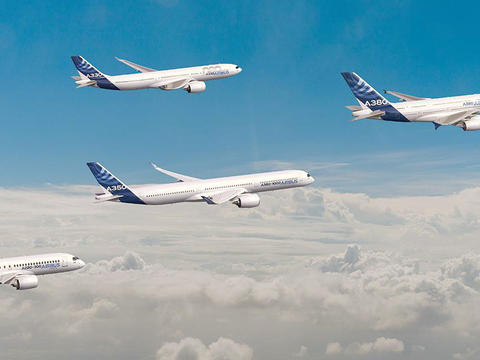
Airbus Passenger Aircraft
Explore Airbus passenger aircraft. Discover comfortable, safe & efficient flight with our A220, A320, A330, A350 & A380 families…
-
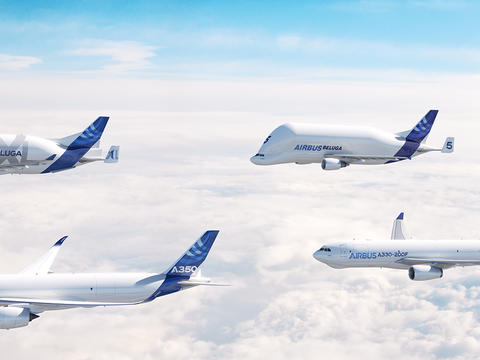
Airbus Freighter Aircraft
Discover Airbus cargo aircraft. Our family includes the new A350F, efficient P2F conversions, and the outsize Beluga super…
-

Airbus Services
Explore the full scope of Airbus Services. We provide technical aviation services, pilot training, aircraft maintenance, and…


Key figures
GLOBAL IMPACT AT A GLANCE


GMF Airbus global market forecast 2025
Preparing for tomorrow's skies
OUR AMBITION
Airbus is shaping the future of aviation by combining long-term vision with immediate action.
Our Global Market Forecast (GMF) highlights two key imperatives: resilient air travel growth and the urgent need for more efficient fleets worldwide. Responding to this strong global demand, Airbus is expanding its operations across continents while also accelerating the industry's transition towards decarbonisation.


1973: An odyssey across South and North America
Joining forces
Our history
Airbus was founded through the industrial cooperation of four European nations (France, Germany, Spain, and the United Kingdom). This model, rooted in the expertise and know-how of Europe's best aerospace minds, was born from a pioneering spirit and a unique culture of collaboration and diversity.
Our story officially took flight when the first Airbus aircraft, the A300B1, took to the skies on 28 October, 1972. Since that moment, we have dedicated ourselves to setting standards in efficiency, safety, and innovation.
We carry this heritage with us, leveraging our deep experience to play our part in shaping the future of aviation.


SAF A350-1000
Advancing decarbonisation
OUR COMMITMENT
Sustainability is at the heart of the Airbus purpose. We are supporting the industry’s transition towards decarbonised aviation by investigating multiple levers.
Airbus’ aim is that advancements in these key areas will drive progress towards meeting the aviation industry’s long-term aspirational goal of reaching net-zero carbon emissions by 2050, as set by ATAG, IATA and ICAO.


Airbus ZEROe 6 pods concept plane
Innovation: bring the vision to reality
Our enabler
Innovation is the enabler that allows Airbus to work towards transforming its vision for sustainable aerospace into a tangible reality. We approach the challenge of decarbonising aviation with rigor and curiosity, understanding that achieving this goal requires developing solutions that are both immediate and revolutionary.
This process involves continuous scientific investigation, flight demonstrators, and crucial partnerships with stakeholders. Innovation is the underlying force that drives all of our strategic efforts, ensuring we can deliver increasingly efficient aircraft today, while building the platforms for the decades ahead.
Through this sustained and collaborative drive, we are focused on turning ambitious goals into concrete progress.

Your future with Airbus
From engineering and digital innovation to manufacturing and customer support, careers at Airbus offer a lot of opportunities.